
Data Minimization vs. Retention: Key Differences
Understand how data minimization and retention differ, and learn practical policies to reduce risk, cut storage costs, and meet compliance requirements.

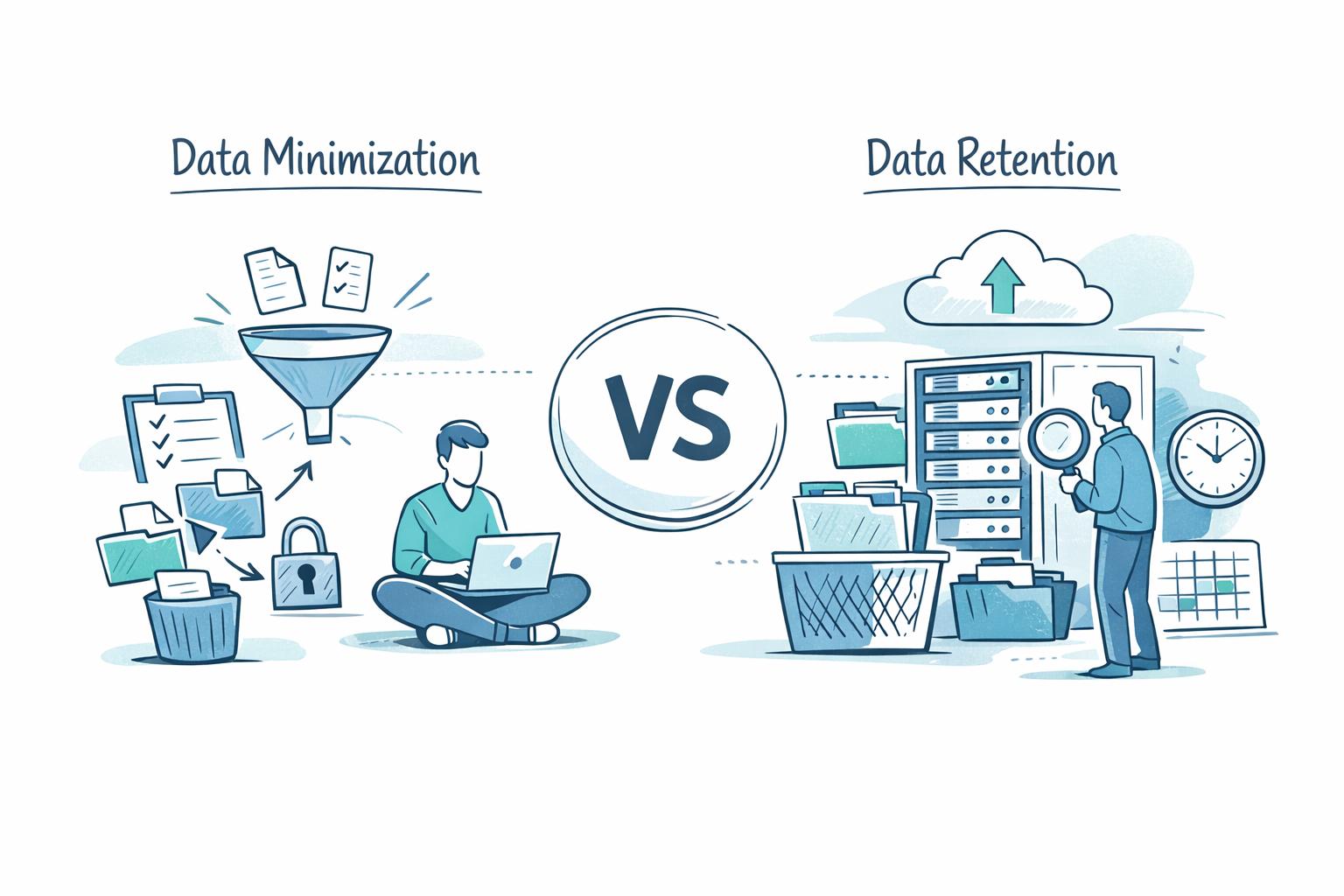
Data minimization and data retention are two critical concepts in managing personal data responsibly. Here's the difference:
- Data minimization ensures you only collect the data you truly need for a specific purpose. It reduces risks by limiting unnecessary data collection.
- Data retention determines how long you keep the data before securely deleting or archiving it, balancing operational needs with legal requirements.
Both principles work together to improve compliance, reduce security risks, and cut costs. Collect less, keep only what’s necessary, and delete when the time is right.
Quick Comparison
| Aspect | Data Minimization | Data Retention |
|---|---|---|
| Focus | What data is collected | How long data is stored |
| Trigger | Purpose-driven (at collection) | Time or event-driven (post-collection) |
| Goal | Reduce risk and storage costs | Ensure compliance and timely disposal |
| Key Tool | Data necessity validation (e.g., ROPA) | Automated retention schedules |
Together, these practices help you manage data responsibly, avoid legal penalties, and safeguard your reputation.
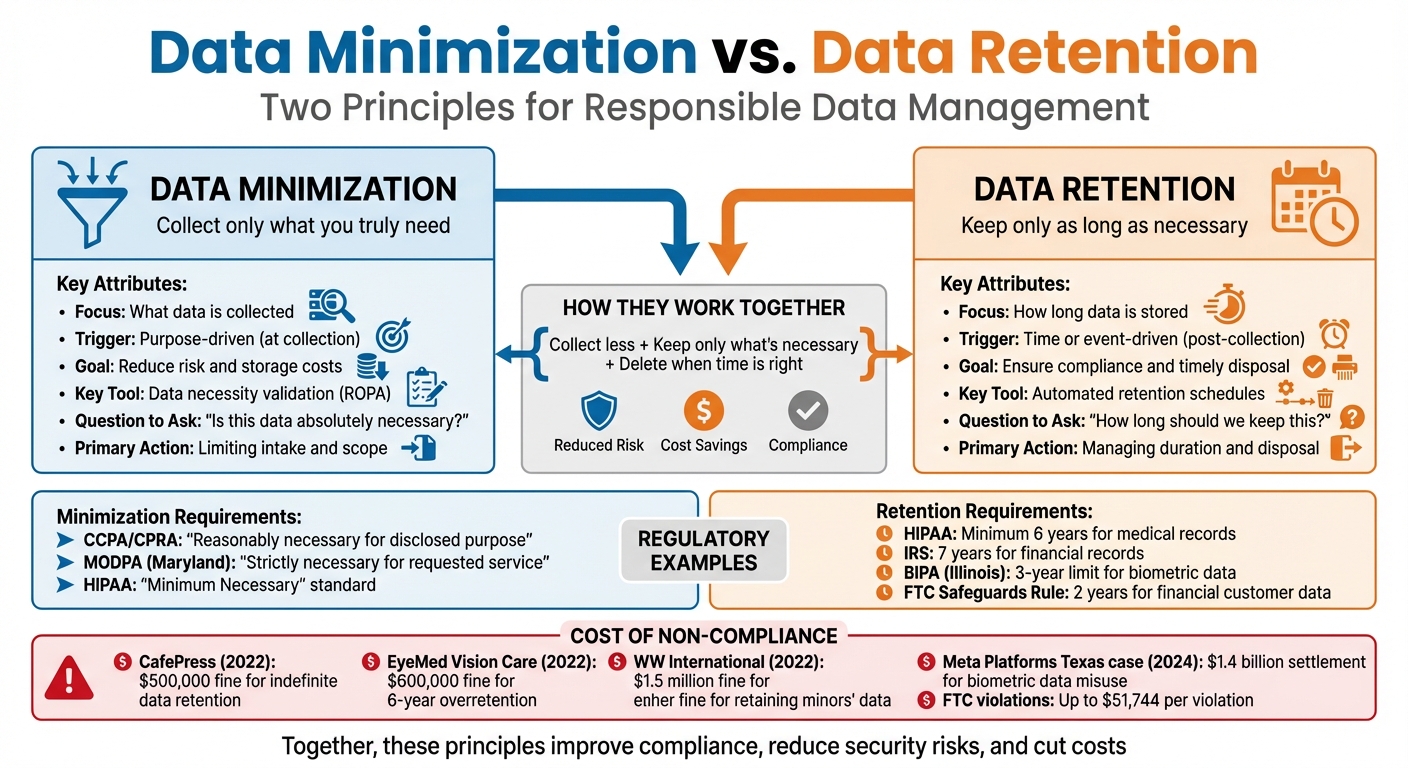
Data Minimization vs Data Retention: Key Differences and Implementation Guide
Core Principles and Purposes
Purpose of Data Minimization
Data minimization emphasizes collecting only the information that is absolutely necessary. By limiting data collection to what is adequate, relevant, and necessary for a specific, clearly defined purpose, organizations can significantly reduce their "attack surface" - the less data you collect, the less there is to safeguard in the event of a breach.
Beyond security, this approach also trims costs. When you avoid gathering unnecessary data, you save on storage, migration, and management expenses. It’s not just about efficiency - it’s about compliance too. Regulators now view data minimization as a legal obligation, not just a best practice. For instance, in June 2022, the FTC imposed a $500,000 fine on CafePress for holding onto consumer data indefinitely without a valid business purpose. The agency labeled this practice as an unfair trade violation. The takeaway? Holding onto data without a clear need is not just risky - it’s indefensible.
While minimization focuses on limiting what data is collected, retention policies determine how long that data is kept.
Purpose of Data Retention
Data retention complements minimization by managing how long information is stored and ensuring its secure disposal when no longer needed. Retention policies are designed to balance business needs - like fulfilling contracts, conducting financial analyses, or providing customer support - with legal requirements such as tax audits or industry-specific mandates. These policies ensure that data remains accessible when necessary and is securely discarded afterward.
Retention plays a critical role in maintaining compliance and operational continuity. For example, financial records often need to be kept for seven years to meet IRS regulations, while HIPAA requires healthcare providers to retain medical records for at least six years. However, holding onto data longer than necessary can backfire. In January 2022, the New York Attorney General fined EyeMed Vision Care $600,000 for keeping sensitive health data in an email account for six years - far longer than was reasonable under the SHIELD Act. This case highlights how outdated or redundant data increases both regulatory and security risks. Proper retention policies not only meet legal requirements but also minimize liabilities tied to data overretention.
| Principle | Primary Focus | Core Objective |
|---|---|---|
| Data Minimization | Intake and Scope (What is collected) | Reduce risk exposure and storage costs |
| Data Retention | Duration and Disposal (How long it is kept) | Ensure compliance and business continuity |
sbb-itb-f3ffd9f
Key Differences in Implementation
Scope and Focus
Data minimization is all about limiting the data you collect - keeping it to only what’s adequate, relevant, and necessary for a specific purpose. Think of it as setting strict boundaries right at the point of data intake.
On the other hand, data retention focuses on how long you hold onto that data. It’s about managing the lifecycle of the information you’ve collected - from active use to archiving and, eventually, disposal. Together, these approaches ensure you don’t collect excessive data and that you don’t keep outdated information hanging around longer than needed. Their distinct scopes naturally lead to different triggers and methods for implementation.
Triggers for Action
The triggers for these two principles couldn’t be more different. Data minimization kicks in when you’re defining a new business process or objective. It’s purpose-driven, asking the question: “Is this data absolutely necessary?” right at the point of collection.
Data retention, by contrast, is time-based or event-based. It’s triggered when a specified time period ends or when a particular event - like the conclusion of a customer relationship - occurs. For example, the FTC Safeguards Rule requires financial institutions to dispose of customer data within two years of its last use, unless there’s a valid business or legal reason to keep it longer. These differing triggers mean that each principle requires its own tailored approach to implementation.
Implementation Methods
The tools and techniques for implementing these principles vary significantly. For data minimization, organizations rely on tools like Records of Processing Activities (ROPA) and data mapping. These help justify each piece of data collected, ensuring every field serves a clear purpose. Field-level analyses and adequacy checks are key steps in this process.
Data retention, in contrast, leans on automated retention schedules and "weeding" processes. These systems tag data with retention dates when it’s created, triggering workflows to either delete or archive the data once its designated period is up.
| Feature | Data Minimization | Data Retention |
|---|---|---|
| Primary Focus | Collection and Intake | Storage and Disposal |
| Action Trigger | Purpose-driven (Necessity) | Time or Event-driven (Duration) |
| Key Tool | ROPA (Records of Processing Activities) | Retention Schedules |
| Technical Method | Data necessity validation | Automated deletion/archiving |
| Goal | Reduce incoming data | Ensure data doesn’t outlive its utility |
Benefits and Risks
Benefits of Data Minimization
Collecting only the data you truly need can save a lot of money. With less information to store, maintain, and secure, organizations cut down on storage, labor, and maintenance expenses. Plus, by limiting the amount of sensitive data collected, you reduce your exposure to potential breaches. This is a big deal when you consider the financial and reputational fallout that can come with a data leak.
Another perk? Your systems run smoother. Getting rid of redundant, outdated, or trivial (ROT) data improves processing speed, simplifies analytics, and boosts overall database efficiency. From a legal standpoint, data minimization helps you stay on the right side of regulations like GDPR and CCPA, which emphasize collecting only what’s "reasonably necessary and proportionate." Non-compliance can be costly - violations of FTC trade rules, for example, come with fines of $51,744 per violation. One example of this was a 2024 enforcement case in Texas, where unauthorized use of biometric data led to a $1.4 billion settlement. Beyond avoiding penalties, sticking to these practices can strengthen customer trust and safeguard your reputation.
Benefits of Data Retention
On the flip side, holding onto data ensures you have what you need when it counts. Many regulations, like HIPAA, GLBA, and Sarbanes-Oxley, require organizations to retain certain records for compliance, audits, tax purposes, or health and safety reviews. Retention also supports smoother operations by keeping essential records accessible for service continuity, dispute resolution, and financial analysis.
In some cases, retaining data for broader purposes - like public interest archiving, scientific research, or statistical analysis - can justify indefinite storage under specific regulatory frameworks. When done thoughtfully, this approach allows for historical analysis that can guide future business strategies and innovation. The key is to ensure retention serves a clear, documented purpose rather than letting it become a default practice.
Risk Comparison
Both strategies come with risks, and it’s all about balancing the trade-offs. Data minimization might mean under-collecting, leaving you without valuable information down the road. On the other hand, data retention can lead to over-collecting, creating a pile of "digital debris" that drives up storage costs and increases your vulnerability to breaches.
For instance, in February 2022, the FTC fined WW International (formerly Weight Watchers) $1.5 million for keeping personal data from minors indefinitely, violating COPPA and the FTC Act.
| Risk Category | Data Minimization (Focus: Intake) | Data Retention (Focus: Storage) |
|---|---|---|
| Security Risk | High volume of initial sensitive data attracts threats | "Digital debris" raises breach costs and impact |
| Compliance Risk | Violating "reasonably necessary" rules under GDPR/CCPA | Fines for storing data beyond required periods |
| Financial Risk | Higher upfront costs for sorting and processing data | Rising expenses for storage, security, and migration |
| Operational Risk | Superficial compliance adds costs without much value | Stale data slows systems and complicates analytics |
Regulatory Requirements and Compliance
Shared Compliance Mandates
Navigating the balance between data minimization and retention isn’t just a practical challenge - it’s a legal one. U.S. regulations demand a careful approach to collecting and retaining data, ensuring compliance with laws that both limit collection and mandate retention.
Key federal regulations like HIPAA, GLBA, and COPPA require organizations to implement security measures while restricting data use to legitimate purposes throughout its lifecycle. On the state level, California's CCPA and CPRA were trailblazers, mandating that data collection must be "reasonably necessary and proportionate" to its stated purpose. Maryland's MODPA takes this a step further, requiring an even stricter standard: collection must be "reasonably necessary and proportionate" to a specific product or service requested by the consumer. Meanwhile, 15 states have adopted the Virginia model, which requires data to be "adequate, relevant, and reasonably necessary" for disclosed purposes - though some argue this standard is less stringent.
Illinois' BIPA stands out with its focus on biometric data, requiring a public retention schedule and mandating destruction within three years of the last interaction or once the data’s purpose is fulfilled. The stakes for non-compliance are high; for instance, a recent Texas case resulted in a $1.4 billion settlement with Meta Platforms, Inc. over unauthorized biometric data use.
This complex regulatory framework highlights the interplay between data minimization and retention, setting the stage for understanding their distinct legal requirements.
Minimization vs. Retention in Compliance
At their core, minimization and retention serve different purposes. Minimization is about limiting the data collected upfront - only gathering what’s necessary for a specific purpose. Retention, on the other hand, focuses on how long that data is kept before it’s deleted or anonymized.
Regulations like GDPR and CCPA require organizations to store data only as long as it’s needed. In contrast, laws such as HIPAA, GLBA, and Sarbanes-Oxley impose minimum retention periods, often six to seven years, for records tied to audits, taxes, or health and safety reviews. This creates a delicate balance: collecting just enough data initially while ensuring records aren’t deleted prematurely, which could lead to violations of retention mandates.
The FTC Act (Section 5) adds another layer, treating the indefinite retention of consumer data without a valid business reason as an "unfair or deceptive practice". In February 2022, the FTC penalized Kurbo Inc. and WW International (Weight Watchers) $1.5 million for retaining minors’ personal data beyond what was legally allowed.
| Regulation | Primary Focus | Minimization Requirement | Retention Requirement |
|---|---|---|---|
| CCPA/CPRA | Consumer Protection | Reasonably necessary for disclosed purpose | No longer than reasonably necessary |
| MODPA (MD) | Consumer Protection | Strictly necessary for requested service | Prohibits sale of sensitive data |
| BIPA (IL) | Biometrics | N/A | 3-year limit or purpose fulfillment |
| HIPAA | Healthcare | "Minimum Necessary" standard | Security safeguards for duration of storage |
| FTC Act | Unfair Practices | Prohibits excessive collection | Prohibits indefinite retention without need |
Compliance Strategies
To effectively manage these requirements, automation and precise data classification are essential. Automating retention schedules and maintaining a Record of Processing Activities ensures timely deletion or archiving in line with legal mandates. For instance, technology can trigger automatic deletion or archiving once a retention period ends or a specific event occurs, such as five years after the last client interaction.
Separating legacy data from current data is another smart strategy. By allowing older, unclassified data to "age out" while applying strict policies to new data, organizations can reduce risks without incurring the high costs of migrating historical records. This approach is particularly effective in highly regulated sectors like healthcare and government, where the attack surface of primary systems needs to remain minimal.
At the point of collection, it’s crucial to define the purpose clearly rather than relying on vague terms of service. For example, instead of collecting Social Security Numbers, businesses can generate internal alternate IDs to reduce the impact of potential breaches. For companies operating in states like California and Colorado, honoring browser-based Global Privacy Control (GPC) signals is legally required for managing consumer opt-outs. Regularly auditing data processing activities can also help identify and remove unnecessary data that’s no longer serving its purpose.
Finally, under the FTC Act, violations of trade regulation rules can result in hefty fines - up to $51,744 per violation. This makes proactive compliance not just a legal necessity but a financial safeguard as well.
How Data Minimization and Retention Work Together
Minimization Limits Intake, Retention Ensures Governance
Data minimization focuses on limiting the amount of data collected, while retention policies manage how long that data is kept. Together, they reflect the privacy principle: "Collect only what you need, and keep it only as long as necessary" – LightBeam.
This two-pronged approach tackles risks at different stages. Minimization reduces potential vulnerabilities by avoiding the collection of unnecessary sensitive information. Retention policies, on the other hand, help prevent a buildup of outdated or unused data, which can increase storage expenses and expose organizations to greater breach risks. In regulated industries, where laws like HIPAA require specific retention periods (e.g., six years for medical records), a well-balanced strategy ensures compliance while avoiding unnecessary data hoarding. This combination provides a way to manage risk while meeting legal obligations.
Benefits of Combining Both Approaches
Bringing together minimization and retention creates a structured, defensible process for data management. This combination improves security and operational efficiency by reducing storage costs and simplifying data retrieval. With outdated files removed, employees can locate relevant information faster, making workflows more efficient. Additionally, robust retention practices help organizations avoid costly regulatory penalties.
Examples for Regulated Industries
In highly regulated fields, applying both minimization and retention principles is essential. Take healthcare, for instance: HIPAA mandates that medical records be stored for at least six years but doesn’t specify a maximum retention period. A hospital adhering to these principles might collect only essential patient data - such as skipping unnecessary details like full home addresses during telehealth visits - and set an automated system to delete records seven years after the last patient interaction. This ensures compliance while preventing indefinite data accumulation.
For government contractors managing sensitive information, a similar approach works well. By separating older, unclassified data from newer records, organizations can allow legacy data to "age out" based on set schedules, while strict minimization rules govern the intake of new data. Automated tools can track timestamps and initiate deletion or archiving once the retention period expires, ensuring ongoing compliance and operational alignment.
Data Collection, Minimization, Retention, Deletion & Necessity | Privacy PowerUp #2
Best Practices for Balancing Both Principles
Striking the right balance between limiting data collection and maintaining effective retention schedules is a cornerstone of strong data governance.
Define and Automate Retention Schedules
Start by cataloging all the data your organization collects and mapping out its lifecycle - from the moment it's created to when it's deleted. For each type of personal information, document the business purpose and legal requirements for keeping it. This step not only ensures compliance but also makes audits much smoother.
To streamline the process, separate older, legacy data from new entries. This allows outdated records to be phased out while applying strict rules to new data. Assign clear responsibilities - typically involving teams like Legal, IT, and Business Units - to oversee retention schedules and deletion workflows.
Take tax records, for instance. If regulations require you to keep them for seven years, an automated system can delete or archive these records securely once that period ends. This approach not only reduces storage costs but also lowers the risk of data breaches. Adding a robust data classification system makes these automated processes even more efficient.
Classify Data for Better Management
Effective data governance hinges on a solid classification system. Group data based on its sensitivity and purpose, such as personally identifiable information (PII), protected health information (PHI), financial records, or general business documents. This ensures each category gets appropriate retention timelines and access controls. Plus, a well-organized classification system makes it easier to identify and remove outdated data that might otherwise linger, taking up space and increasing security risks.
A practical tool for this is a Record of Processing Activities (RoPA). Use it to document the categories of data you handle, their specific elements, and the legal reasons for processing them. Treat this record as a dynamic document that evolves whenever your data collection methods or service offerings change.
Regular monitoring is essential to ensure these classifications remain accurate and effective.
Monitor and Review Policies Regularly
Data management policies aren't static - they require ongoing attention. Conduct yearly compliance checks to ensure retention schedules align with current regulations like GDPR, CCPA, and other privacy laws. By early 2026, for example, 19 U.S. states will have adopted comprehensive data privacy laws emphasizing data minimization.
Make retention and deletion reviews a standard part of management meetings. Track performance indicators such as the amount of unnecessary data removed, adherence to retention policies, and the completion rates of staff training programs. Regularly audit automated systems to confirm that deletion triggers and rules for removing outdated data are working as intended. Also, maintain version control for your retention schedules to keep them up-to-date.
Failing to review policies and properly dispose of data can lead to hefty fines and operational headaches. Enforcement actions have shown the consequences of retaining sensitive data longer than necessary, underscoring the importance of these practices.
Key Takeaways
Data minimization and data retention are two sides of the same coin - working together to manage data responsibly. Data minimization focuses on collecting only what’s absolutely necessary (think: “Do we really need this field?”), while data retention determines how long that data sticks around. Together, these practices help avoid the build-up of redundant, obsolete, or trivial (ROT) data.
The risks of neglecting these principles are real. For instance, regulatory fines can hit six figures, as seen in cases of over-retention. Regulators often focus on whether data practices are reasonable - meaning they should be logical, consistent, systematic, and well-documented. Cases involving minors’ data highlight how seriously these standards are enforced.
To make these principles actionable, start with a detailed data inventory and map how information flows within your organization. Separate outdated legacy records from newer entries, phasing out what’s no longer needed. Implement automated systems to delete data when retention periods expire. For example, the FTC Safeguards Rule mandates a two-year retention period for financial customer data, while Illinois BIPA requires biometric data to be deleted after three years.
FAQs
What are the key advantages of combining data minimization and retention practices?
Combining data minimization with data retention practices can offer organizations a range of benefits. By collecting only the data that’s truly necessary and securely disposing of it when it’s no longer useful, companies can cut down on storage expenses, reduce legal and compliance risks, and clear out unnecessary digital clutter. This approach also improves data governance, helping businesses stay aligned with privacy regulations like GDPR, CCPA, HIPAA, and GLBA.
On top of that, storing less data translates to a smaller attack surface, which enhances cybersecurity and builds trust with customers. When these practices work together, they create a more efficient system: clear retention timelines align with minimization efforts, reducing the amount of data that needs to be managed, audited, or reported. For businesses with intricate IT systems, integrating these principles into their data management processes creates a secure, cost-effective, and regulation-ready environment tailored to their industry’s needs.
What’s the difference between data minimization and data retention, and how do they help with compliance?
Data minimization means gathering and using only the personal information that's absolutely necessary for a specific task or purpose. This concept is a cornerstone of privacy regulations like GDPR and CCPA/CPRA. These laws require businesses to justify why they’re collecting certain data and to avoid holding onto anything unnecessary. By keeping data collection lean, companies not only reduce privacy risks but also simplify processes like handling access, correction, or deletion requests.
Data retention, on the other hand, deals with how long personal information is stored. Regulations like GDPR emphasize that data shouldn't be kept longer than necessary, pushing businesses to establish clear retention policies and conduct regular reviews. Similarly, CCPA/CPRA ties data retention to what’s reasonable for the stated purpose, helping organizations avoid holding onto data longer than they should - something that could lead to liabilities.
When combined, these practices ensure businesses stay compliant while improving efficiency and reducing risks. Partnering with experts like Integrity Tech can make this process smoother. They offer tailored data governance solutions, including automated monitoring and secure disposal, to help businesses stay on the right side of privacy laws.
What risks arise from not following proper data minimization and retention practices?
Neglecting to practice proper data minimization and retention can lead to serious consequences - legal, financial, and operational. Collecting more data than necessary or keeping it longer than required can violate privacy laws like GDPR, CCPA, HIPAA, or GLBA. These violations can result in hefty fines, lawsuits, and damage to your reputation. In the U.S., the Federal Trade Commission (FTC) has also ramped up its focus on improper data disposal, adding another layer of compliance risk.
But it’s not just about regulations. Holding onto unnecessary data drives up costs and exposes your organization to cyber threats. Larger data stores are prime targets for ransomware and other attacks. Plus, excess data can slow down your systems, complicate your response to incidents, and increase the likelihood of accidental leaks.
By partnering with Integrity Tech, you can automate data controls, enforce retention policies, and securely dispose of outdated information. This approach helps reduce risks, ensures compliance, and safeguards your critical assets.
Related Blog Posts
Related Blogs
.svg)
Ready to Transform
Your Customer Management?
Sign up today and see the difference Syncro can make for your business.